Preparing Rwandan industry for nuclear infrastructure
For UNECA and the Rwanda Atomic Energy Board, AESG assessed whether Rwandan industry can supply nuclear infrastructure, and how to build that capability.
Nuclear infrastructure depends on far more than the technology at its centre. It draws on manufacturers, engineering services, construction firms and supporting industries, all working to international nuclear-grade standards, with the certification and quality assurance to show it.
From January to May 2026, AESG worked as local consultant on an assignment coordinated by the UN Economic Commission for Africa (UNECA) with the Rwanda Atomic Energy Board (RAEB), assessing how ready Rwandan industry is to take part in the country's nuclear infrastructure development, and the value chains around it.
The question
The assignment built on RAEB's initial industry assessments and widened them to technical, institutional and economic readiness across key sectors. At its centre were two questions: can Rwandan industry support nuclear infrastructure through local manufacturing, engineering services, construction and supporting industries; and how could those industries integrate into global nuclear supply chains through international standards, certification and quality assurance?
Six workstreams
- Industrial readiness: Rwanda's industrial base relevant to nuclear infrastructure, covering technical capabilities, production capacity and compliance with international nuclear-grade standards, alongside quality assurance systems and certification readiness.
- Value chains and localisation mapping: backward and forward linkages, the local industries able to take part in nuclear construction, manufacturing and services, and a database of local suppliers and technical service providers.
- Capacity gaps and skills: gaps in technical skills, industrial capability and certification systems, with training priorities and what technology transfer and industrial upgrading would require.
- Policy and institutions: national industrial policies and strategies, procurement frameworks, accreditation systems and regulatory structures, with proposals to widen local industry participation.
- Stakeholder engagement: structured consultation with government institutions, regulators, the private sector and industry, to validate the findings and assess readiness.
- An Industrial Localisation Roadmap: evidence-based recommendations aligned with international practice and with national industrialisation objectives.
Beyond the firms themselves
Whether local firms can take part depends on more than their own capabilities. The analysis therefore also examined the policy instruments, incentives and institutional reforms needed to build domestic capability, and identified strategic entry points for local industry.
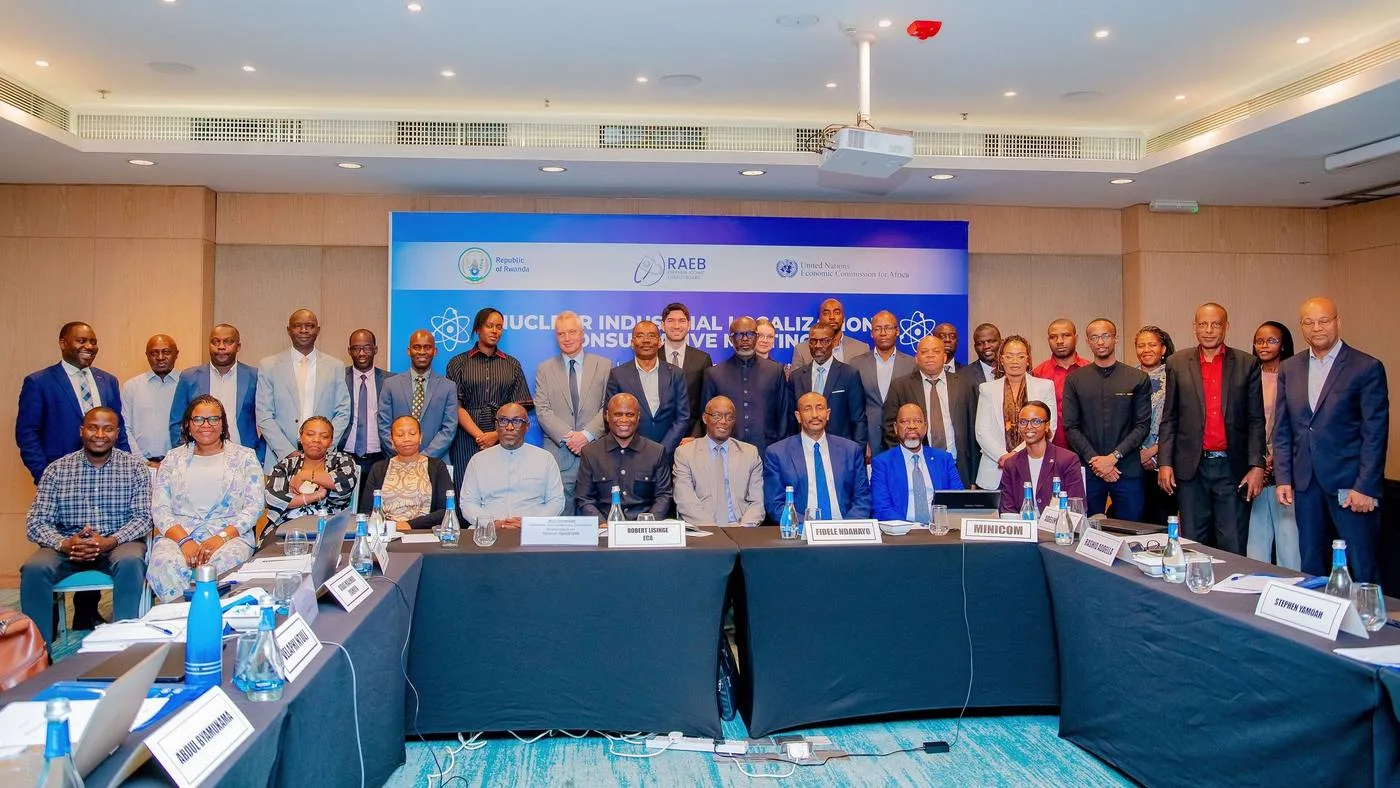
Findings were validated with the institutions and firms that would act on them, including at the Nuclear Industrial Localization Consultative Meeting in Kigali (pictured).
In AESG's work
The assignment brought together AESG's research and policy practice: establishing where a sector starts, mapping who can take part, and turning the evidence into a roadmap institutions can act on. The full entry is in our project record.